CMS Ban on AO Consulting: What Healthcare Leaders Need to Know
Important Regulatory Update: New CMS Limits on Accrediting Organizations & Your Compliance Strategy
Executive Briefing: A Major Shift in Healthcare Accreditation
The Centers for Medicare & Medicaid Services (CMS) finalized its landmark rule, Strengthening Oversight of Accrediting Organizations (AOs) and Preventing AO Conflicts of Interest. This policy fundamentally reshapes how healthcare facilities prepare for surveys and maintain continuous regulatory readiness.
For decades, many healthcare systems relied on the consulting arms of their primary Accrediting Organizations (such as The Joint Commission or DNV) for mock surveys, standard interpretations, and pre-survey preparation. Under the new CMS final rule, this practice is strictly prohibited due to inherent conflicts of interest.
As CMS Administrator Dr. Mehmet Oz noted regarding the oversight of accrediting bodies: "The work accrediting organizations do is vital, but it also raises an age-old question: who watches the watchmen? The answer is, we do."
Breakdown: What the New CMS Rule Changes
To preserve objective survey findings and eliminate the appearance of bias, CMS has established clear boundaries between the organizations that enforce standards and the entities that provide advisory consulting.
CMS AO CONFLICT RULE
PROHIBITED: AO Fee-Based Consulting
• No mock surveys by your designated AO before initial survey
• No fee-based consulting within 12 months prior to reaccreditation
• No AO consulting following complaint investigations
PERMITTED & RECOMMENDED: Independent 3rd-Party Consulting (i.e. HCE Global)
• 100% compliant at any time during the accreditation cycle
• Free from conflicts of interest (3rd parties do not issue status)
Key Takeaways for Healthcare Facilities:
- 12-Month Pre-Survey Blackout: An AO (or its associated consulting division) cannot provide fee-based consulting services to a healthcare facility within 12 months prior to a scheduled re-accreditation survey or before an initial accreditation survey.
- No AO Mock Surveys or Complaint Advisory: AOs are barred from conducting mock audits or offering fee-based advisory work in response to complaints or deficiency findings at facilities they evaluate.
- Unannounced & Standardized Surveys: CMS is enforcing strictly unannounced surveys and aligning AO survey standards directly with Medicare Conditions of Participation (CoPs) and state survey agency protocols.
- Third-Party Consulting Explicitly Approved: CMS explicitly noted that healthcare organizations are fully permitted and encouraged to seek fee-based consulting from independent third parties. Third-party consultants pose zero conflict of interest because they do not make final accreditation or deeming determinations.
Navigating Compliance with HCE Global
With Accrediting Organizations locked out of advisory roles, healthcare leadership teams need a trusted, conflict-free consulting partner to ensure continuous survey readiness without compromising compliance integrity.
HCE Global serves as your premier, independent regulatory compliance partner. Because HCE Global operates as an independent consultancy, engaging our team carries ZERO CONFLICT OF INTEREST under CMS regulations. We provide objective expertise across the entire spectrum of healthcare operations and accreditation standards.
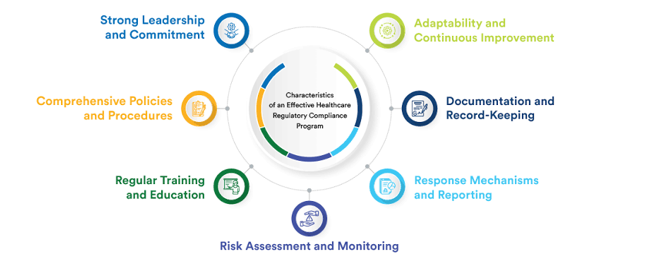
Our Scope of Expertise
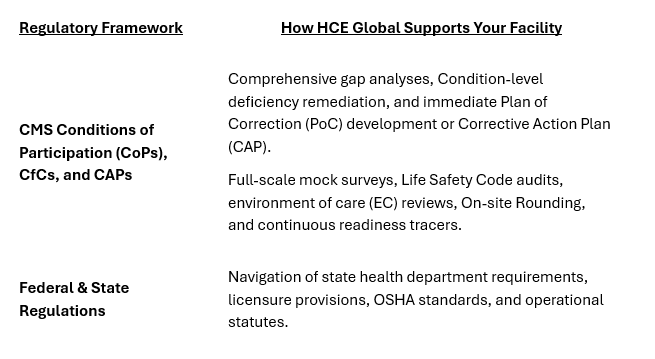
Core Services Offered by HCE Global
"True survey readiness is not a one-time event prior to an audit; it is a culture of continuous operational excellence."
- Independent Mock Surveys & Gap Analyses: Mirroring real-world survey protocols with zero advance notice to identify vulnerabilities across clinical, administrative, and physical environment domains.
- Immediate Jeopardy (IJ) & Deficiency Remediation: Fast-response consulting to help facilities resolve Immediate Jeopardy findings, draft acceptable Plans of Correction (PoC), and execute sustained monitoring plans.
- Policy & Procedure Alignment: Reviewing and updating institutional policies to ensure strict alignment with current CMS CoPs, AO standards, and state regulations.
- Education & Staff Training: Conducting customized in-services for leadership, clinical staff, and quality departments to build a proactive compliance environment.
Secure Your Compliance Partnership Today
The regulatory landscape has changed, but your commitment to patient safety and operational excellence remains constant. Do not wait for an unannounced survey or complaint to discover compliance gaps.
Partner with HCE Global—your independent, expert partner in navigating CMS, CIHQ, Joint Commission, DNV, and state regulatory requirements.
- Email: info@hceglobal.com
- Phone: (800) 813-7117
- Website: www.hceglobal.com/