The Vital Sign: “Spring Forward”

As we "spring forward" into 2026 (don't forget: Daylight Savings hits March 8!), the focus shifts from the winter's "survival mode" to strategic optimization. 


With National Patient Safety Awareness Week (March 8–14) upon us, this month is about the visible and invisible systems that keep our patients—and our licenses— safe.

National Patient Safety Awareness Week: "Team Up for Patient Safety"

This year’s theme, “Team Up for Patient Safety,” is more than just a tagline; it’s a regulatory requirement. Under the Accreditation 360 model, surveyors are looking for evidence that the "team" includes the patient.

  • The Shift: We are moving away from "doing for" the patient to "doing with" them.
  • Compliance Tip: Ensure your clinical teams are documenting "Patient/Family Engagement" in care planning. Surveyors are currently tracing patient charts to see if the family's voice is present in the discharge and safety education notes.


Facility Management & Infection Control: The Water Management Audit

As the weather warms, your water systems become a primary infection prevention risk. Legionella Risk Assessment: If you haven’t updated your risk assessment for "dead legs" in the plumbing after recent facility renovations, now is the time.


Utilization Review: The "WISeR" Way to Audit

As of January 2026, CMS officially launched the WISeR (Wasteful and Inappropriate Services Reduction) program. If you operate in one of the pilot states (TX, AZ, NJ, OH, OK, WA), your Utilization Review (UR) team is likely feeling the heat.

  1. AI Scrutiny: CMS is now using AI-assisted screening for prior authorizations.
  2. The "Explainability" Rule: If your facility uses AI to help with UR decisions, you must be able to "explain the math." Regulators are cracking down on "black box" algorithms that deny care without a clear, clinical justification by a licensed reviewer.
  3. Inpatient-Only (IPO) List: Remember that 2026 saw the removal of 285 procedures from the IPO list. Your UR team must ensure these musculoskeletal and orthopedic cases are being channeled to the appropriate outpatient setting to avoid automatic denials.
Cluster of blue bacteria-like rods under a microscope on a white background

Environmental Services (EVS): The Invisible Frontline

During Patient Safety Week, we often highlight doctors and nurses, but your EVS team is the primary defense against Candida auris and other emerging pathogens.

  • Standardization: 2026 is the year of "Chemical Stewardship." Ensure your EVS team isn't "mixing and matching" disinfectants.
  • Compliance Check: Are your EVS "high-touch" cleaning logs digitized? Paper logs are increasingly viewed by surveyors as "low-fidelity" evidence.


The Candid Corner: The HTI-1 Health IT deadline on March 1st probably felt like a sprint to a wall. If your systems are still glitching, don't hide it—document the "good faith effort" and your vendor’s mitigation plan. Surveyors in 2026 are surprisingly forgiving of tech hurdles if you have a paper-trail plan for the downtime.

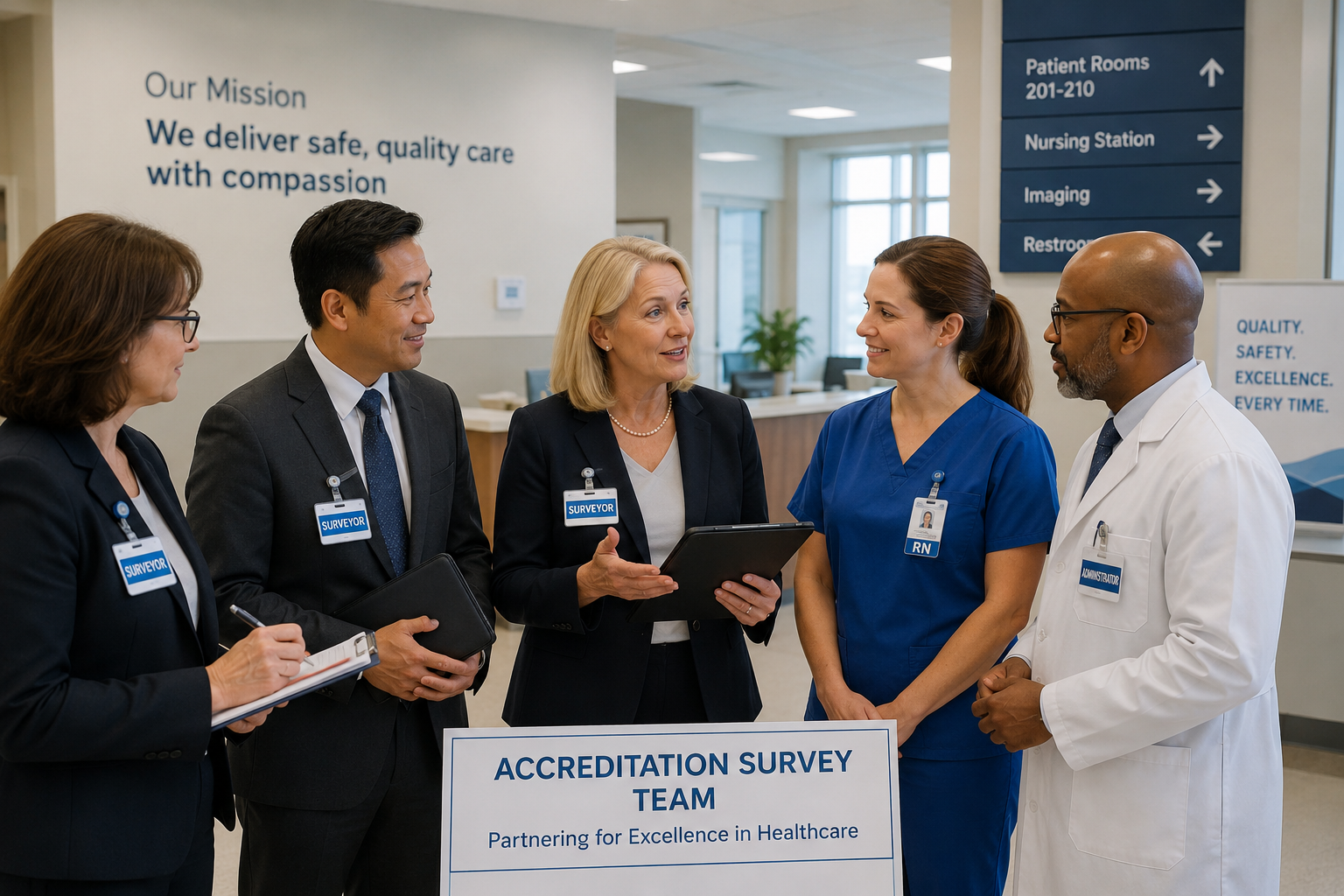
Hospital staff holding tablets during an accreditation survey team visit in a hallway
By Kim . July 1, 2026
As your accreditation survey approaches, it is important that all staff understand not only the standards and processes being evaluated, but also the professional etiquette that contributes to a successful survey experience.
Woman sitting at a desk, holding her shoulder while working on a laptop in a bright room.
June 4, 2026
OSHA's General Duty Clause and Ergonomic Risks Under Section 5(a)(1) of the Occupational Safety and Health Act (the General Duty Clause), healthcare employers are legally required to provide a work environment free from recognized hazards that cause or are likely to cause death or serious physical harm. Manual patient lifting, transferring, and repositioning represent significant ergonomic hazards. OSHA actively inspects healthcare systems for musculoskeletal disorders (MSDs) and mandates that hospitals implement engineered control solutions, such as ceiling lifts, sit-to-stand devices, and friction-reducing slide sheets.
May 5, 2026
The Technical Baseline: NFPA 99 Health Care Facilities Code NFPA 99 (2012 Edition, as mandated by CMS) establishes risk-based categories for electrical and gas systems based on the risk to patients. Category 1 spaces are those where procedures are performed that could result in major injury or death if utility systems fail. Under Chapter 6 (Electrical Systems), facilities must maintain isolated power systems (IPS) and line isolation monitors (LIM) in wet procedure locations to protect patients against electrical shock.  Survey Vulnerabilities: CIHQ and Joint Commission Directives During surveys, both TJC and CIHQ closely inspect the testing logs for these specialized electrical environments. TJC Standard EC.02.05.01 requires facilities to manage utility risks, specifically focusing on the routine inspection of ground- fault circuit interrupters (GFCIs) and the regular calibration of LIM alarms. CIHQ surveyors frequently evaluate surgical staff on their understanding of the LIM panel: if an alarm sounds, do clinicians know that it signifies a critical loss of electrical isolation that could cause patient harm if a second fault occurs? OSHA 29 CFR § 1910 Subpart S Alignment While NFPA 99 protects the patient, OSHA Subpart S (Electrical Safety) safeguards the clinical staff operating the machinery. Employers must ensure all electrical medical devices are free from recognized hazards. Exposed wiring, unapproved extension cords, or failing to lock out/tag out malfunctioning medical hardware violates OSHA standards and places both employees and patients at immediate risk.